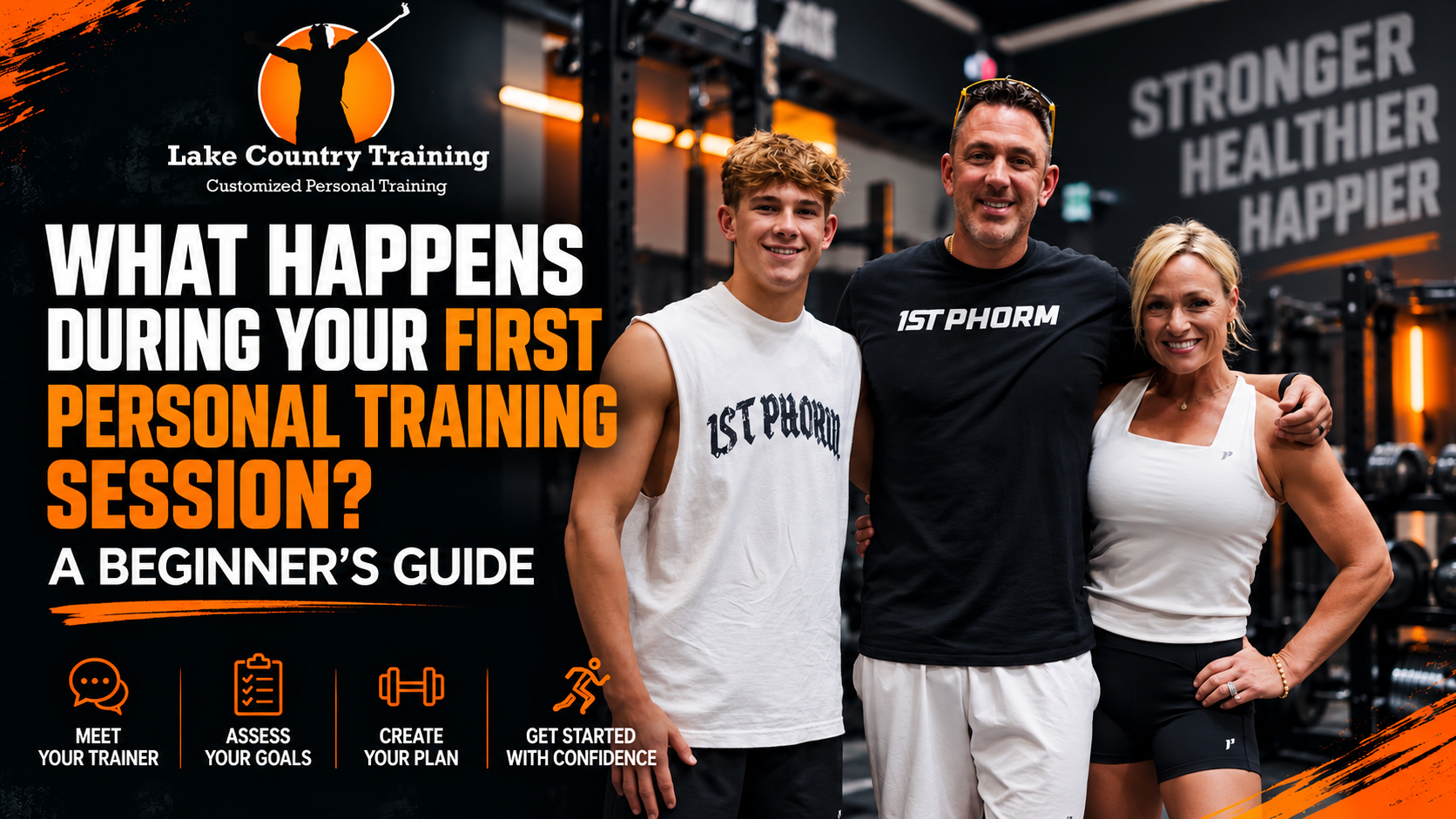
What Happens During Your First Personal Training Session? A Beginner’s Guide
Starting your first personal training session can be one of the best decisions you make for your health, fitness, and long-term well-being.
However, taking that first step can also feel intimidating.
Maybe you’ve never worked with a personal trainer before. Perhaps it’s been years since you exercised consistently. Or maybe you’ve been working out on your own but aren’t seeing the results you want.
Whatever your situation, it’s completely normal to wonder what happens during your first personal training session.
Will you be expected to complete a difficult workout? Do you need to be in shape before you start? What questions will your trainer ask? And how does the process actually work?
At Lake Country Training, we believe personal training should begin with understanding the individual not handing everyone the same workout.
Your first session is an opportunity to discuss your goals, review your exercise experience, evaluate your starting point, and begin developing a realistic plan.
Here’s what you should know before getting started.
What Is the Purpose of Your First Personal Training Session?
The first personal training session is about establishing a foundation.
Before creating an effective exercise program, a trainer needs to understand several things about you.
These include your current fitness level, exercise history, personal goals, schedule, and any limitations that could affect your training.
Someone who wants to lose 30 pounds may need a different approach than someone preparing for an athletic event.
A person who has never lifted weights will have different needs than someone who has trained consistently for 20 years.
Likewise, an older adult interested in improving strength and balance may require a different program than a younger client focused on building muscle.
A quality personal trainer recognizes these differences.
The purpose of your first session is to determine where you are today and establish a realistic plan for where you want to go.
That process may include a consultation, movement assessment, introductory exercises, or a combination of these elements.
Not every first session needs to involve a full workout.
Step 1: Discussing Your Fitness Goals During Your First Personal Training Session
One of the first things your trainer should do is ask about your goals.
This conversation helps establish the direction of your training program.
Common personal training goals include:
- Losing body fat.
- Building muscle.
- Increasing strength.
- Improving cardiovascular fitness.
- Developing better mobility and flexibility.
- Improving balance and coordination.
- Returning to consistent exercise.
- Preparing for sports or recreational activities.
- Maintaining physical independence as you age.
- Improving overall health and fitness.
However, identifying a goal is only the beginning.
A trainer should also ask why that goal matters to you.
For example, someone who wants to lose weight may be motivated by improving energy, becoming more physically capable, or feeling better during everyday activities.
Someone who wants to increase strength may be preparing for an outdoor activity or simply trying to maintain muscle as they get older.
Understanding your motivation helps your trainer create a program that fits your priorities.
Setting Realistic Expectations
A good trainer should be encouraging without promising unrealistic results.
Significant improvements in strength, fitness, or body composition require consistent effort over time.
Your trainer should help establish achievable short-term objectives that contribute to your larger goals.
Instead of focusing exclusively on a final number on the scale, you might begin by improving exercise consistency, increasing strength, or establishing better nutrition habits.
These measurable improvements help build momentum.
Step 2: Reviewing Your Health & Exercise History
Before beginning an exercise program, your trainer should ask about your health and previous training experience.
This information helps identify exercises that may be appropriate and situations that require additional caution.
Topics may include:
- Previous injuries or surgeries.
- Current joint discomfort or movement limitations.
- Existing medical conditions.
- Exercise restrictions from healthcare professionals.
- Current physical activity levels.
- Previous strength training experience.
- Medications that may affect exercise tolerance.
- Activities you enjoy or prefer to avoid.
You should be honest when answering these questions.
For example, if you’ve experienced shoulder discomfort during pressing exercises, your trainer needs to know.
If you have difficulty getting up from the floor or experience pain during certain movements, that information matters.
Your trainer can use these details to modify exercises and determine whether medical clearance or referral is appropriate.
Personal trainers do not diagnose medical conditions or replace physicians and physical therapists.
Their role is to design and supervise fitness programs within their professional scope.
Step 3: Evaluating Your Current Fitness Level
Many people assume their first personal training session will involve an exhausting workout.
That isn’t necessarily the case.
Depending on your needs, the trainer may begin with basic movement observations or simple fitness assessments.
The objective is to understand your current abilities not to prove how much exercise you can tolerate.
Movement Assessment
A trainer may observe how you perform fundamental movements such as:
- Sitting down and standing up.
- Squatting.
- Bending at the hips.
- Reaching overhead.
- Pushing and pulling.
- Balancing on one leg.
- Walking or stepping.
These observations can help guide exercise selection.
For example, someone with limited ankle mobility may require a modified squat.
Someone who struggles with balance may begin with supported exercises.
A person with excellent movement control and previous training experience may be ready for more challenging exercises.
The purpose is to establish an appropriate starting point.
Strength Assessment
Your trainer may introduce basic resistance exercises to evaluate technique and current strength.
These could include body-weight movements, resistance bands, dumbbells, or weight machines.
There is usually no reason to attempt a maximum lift during an introductory session.
A controlled assessment provides useful information without requiring unnecessary fatigue.
Cardiovascular Fitness
Depending on your goals and health history, the trainer may also discuss or evaluate your current cardiovascular fitness.
This could involve a brief walk, stationary cycling, or another appropriate low-intensity activity.
The assessment should match your current ability.
Someone who has been inactive for several years should not be expected to complete the same introductory workout as an experienced athlete.
Step 4: Learning Proper Exercise Technique
One of the biggest advantages of working with a personal trainer is receiving individualized instruction.
Many people struggle to determine whether they are performing exercises correctly.
They may copy workouts from social media, follow generic programs, or use gym equipment without understanding proper technique.
During your first session, your trainer may introduce a few basic exercises and explain how to perform them.
Understanding Movement Mechanics During & After Your First Personal Training Session
A trainer may help you learn how to:
- Maintain appropriate posture during an exercise.
- Control the lowering and lifting phases of a movement.
- Position your feet and hands.
- Use an appropriate range of motion.
- Breathe during resistance training.
- Select a manageable starting weight.
- Recognize when technique begins to deteriorate.
Good exercise technique is not about making every movement look identical for every person.
Body proportions, mobility, training experience, and individual limitations can influence how an exercise should be performed.
The objective is to develop effective movement patterns appropriate for your body.
Starting With the Right Resistance
A common mistake among beginners is choosing weights that are too heavy.
Another mistake is assuming that every exercise must feel extremely difficult to be effective.
Your first training session should establish a resistance level that allows you to perform the movement with reasonable control.
As you gain experience and strength, the resistance can gradually increase.
Progressive training works best when the starting point is appropriate.
Step 5: Building A Personalized Workout Plan
Once your trainer understands your goals, abilities, and schedule, the next step is developing a program.
This is where personal training becomes different from following a random workout.
A structured program should consider:
- Your primary fitness goals.
- How many days per week you can realistically train.
- Your current strength and conditioning.
- Available equipment.
- Previous injuries or limitations.
- Exercise preferences.
- Recovery needs.
- Your ability to remain consistent.
For example, someone who can train three days per week may benefit from a full-body strength program.
Another person may prefer a combination of supervised training sessions and independent workouts.
An experienced athlete may require a more specialized approach.
The best program is not necessarily the most complicated one.
It’s the program that appropriately challenges you, fits your schedule, and allows you to make measurable progress.
Step 6: Discussing Nutrition & Lifestyle Habits
Exercise is important, but it is only one component of a successful fitness program.
Nutrition, sleep, daily activity, and consistency also influence results.
Depending on your goals, your trainer may discuss several lifestyle factors.
Nutrition Habits
For clients interested in losing body fat or building muscle, nutrition is particularly important.
Your trainer may ask about your current eating habits, meal frequency, protein intake, and challenges with consistency.
The objective is not necessarily to overhaul your entire diet immediately.
Instead, your coach may help identify practical improvements.
Examples include eating more protein, improving meal planning, increasing fruit and vegetable intake, or establishing more consistent eating patterns.
Sleep and Recovery
Poor sleep and inadequate recovery can affect training performance and exercise consistency.
Your trainer may ask how much sleep you typically get and whether your schedule allows sufficient recovery between workouts.
Daily Physical Activity
Structured workouts are only part of your total activity.
Walking, recreational activities, household tasks, and other movement throughout the day also contribute to overall fitness.
Your trainer may help establish realistic activity goals outside supervised sessions.
Supplementation
Some clients also have questions about protein powders, creatine, vitamins, or other supplements.
Supplements may have a place in a well designed program, but they should support not replace proper nutrition and consistent training.
At Lake Country Training, we emphasize establishing the fundamentals before adding unnecessary products.
Do You Need To Be In Shape Before Hiring A Personal Trainer?
Absolutely not.
This is one of the biggest misconceptions about personal training.
You do not need to lose weight, build muscle, or improve your endurance before beginning.
In fact, personal training can be especially valuable when you’re unsure where to start.
A qualified trainer should be capable of working with different experience levels.
That includes complete beginners, people returning after a long break, experienced exercisers, and older adults.
Your current fitness level is simply your starting point.
The purpose of hiring a trainer is to receive guidance that helps you improve from there.
What Should You Bring To Your First Personal Training Session?
Preparing for your first session doesn’t need to be complicated.
A few basic items can help make the experience more comfortable.
Comfortable Workout Clothing
Wear clothing that allows you to move freely.
Choose athletic shoes appropriate for the activities you’ll be performing.
Water
Bring water so you can stay hydrated during your session.
Relevant Health Information
Be prepared to discuss previous injuries, medical restrictions, and any concerns that may affect exercise.
If a healthcare professional has provided exercise instructions or restrictions, share those with your trainer.
Questions About Your Goals
Think about what you want to accomplish.
You may want to ask about training frequency, exercise selection, nutrition, or what realistic progress looks like.
An Open Mind
You do not need to know how to perform every exercise.
That’s part of the reason you’re working with a trainer.
Be willing to learn, ask questions, and focus on building a strong foundation.
Will Your First Personal Training Session Be Difficult?
Your first session should be appropriately challenging for your current fitness level.
That does not mean it should leave you exhausted, extremely sore, or unable to function normally the following day.
A good trainer should prioritize understanding your abilities and teaching proper movement before increasing intensity.
Some clients may complete a moderate introductory workout.
Others may spend more time discussing goals, reviewing movement patterns, or learning basic exercises.
The exact structure depends on the individual and the trainer’s assessment process.
A productive first session is measured by what you learn and establish not by how sore you feel afterward.
How Long Does A First Personal Training Session Last?
Session length varies depending on the trainer, training environment, and services provided.
Some introductory appointments may be approximately 30 minutes, while others may last 45–60 minutes or longer.
The first meeting may also be structured as a separate consultation rather than a full training session.
Before scheduling, ask what the appointment includes and whether there is anything you should prepare.
At Lake Country Training, the introductory process is designed around understanding your goals and determining the most appropriate coaching approach.
What Happens After Your First Session?
Your first session is the beginning of the process.
Once your trainer understands your goals and abilities, you can begin following a structured program.
Over time, the trainer may adjust:
- Exercise selection.
- Resistance and repetitions.
- Training volume.
- Cardiovascular conditioning.
- Recovery periods.
- Weekly workout frequency.
- Nutrition and activity goals.
Progress should be evaluated regularly.
For example, improvements may include lifting heavier weights with proper technique, completing more repetitions, walking longer distances, or feeling more confident with everyday movement.
Changes in body composition may also be tracked when relevant.
The goal is to use measurable progress to guide future decisions rather than constantly changing workouts without a plan.
How Do You Know If A Personal Trainer Is Right for You?
Choosing the right trainer is an important decision.
A good personal trainer should take the time to understand your needs and explain their approach.
Look for someone who:
- Has appropriate education, qualifications, and experience.
- Asks questions before prescribing exercises.
- Understands your goals and limitations.
- Explains exercises clearly.
- Provides a structured plan.
- Adjusts workouts based on your progress.
- Encourages consistency without relying on unrealistic promises.
- Communicates professionally.
- Recognizes when medical evaluation or referral is necessary.
You should feel comfortable asking questions and discussing concerns.
Personal training is a professional coaching relationship, and communication matters.
Your First Personal Training Session At Lake Country Training
At Lake Country Training, we take an individualized approach to fitness coaching.
With more than 25 years of experience in personal training and fitness, we understand that clients come to us with different backgrounds, abilities, and goals.
Some want to lose body fat.
Others want to build muscle, improve athletic performance, increase strength, or maintain physical independence.
We work with adults, athletes, and individuals at different stages of their fitness journeys.
Our services include:
- Individualized personal training.
- Strength and muscle development.
- Weight-loss coaching.
- Nutrition coaching.
- Youth athletic performance.
- Mobility and functional fitness.
- Online personal training.
- In-home and private training options.
We serve Oconomowoc and surrounding Lake Country communities, including Delafield, Hartland, Pewaukee, Nashotah, Okauchee, Merton, Summit, Dousman, and Waukesha.
Whether you’re completely new to exercise or looking for more structure and accountability, our objective is to help you develop a realistic program that supports your goals.
Frequently Asked Questions About Your First Personal Training Session
Do I Have to Work Out During My First Session?
Not necessarily. Some introductory appointments focus primarily on discussing goals, reviewing health history, and assessing movement. Others include a short workout. Ask your trainer what to expect.
Will a Personal Trainer Judge My Fitness Level?
A professional trainer should use your current fitness level to establish an appropriate starting point, not to judge you. Everyone begins with different abilities and experiences.
How Many Personal Training Sessions Do I Need?
That depends on your goals, schedule, experience, and preferred level of support. Some people benefit from one supervised session per week, while others prefer multiple sessions.
Can I Hire a Personal Trainer If I’m Overweight?
Yes. Personal training can be adapted for individuals at different body weights and fitness levels. Your trainer should select exercises appropriate for your current abilities.
Is Personal Training Only for Beginners?
No. Experienced exercisers and athletes may benefit from individualized programming, technique feedback, accountability, and specialized coaching.
Can I Work With a Personal Trainer at Home?
Yes. In-home personal training may be an option depending on your location, equipment, and training needs. Lake Country Training offers in-home coaching in the Oconomowoc and Lake Country area.
What If I Have an Old Injury?
Tell your trainer about any injury history, ongoing symptoms, or medical restrictions. Exercise selection may need to be modified, and some situations require clearance or guidance from a healthcare professional.
The Bottom Line: Your First Session Personal Training Session Is About Starting The Right Way
Your first personal training session should not be intimidating.
It’s an opportunity to discuss your goals, understand your current fitness level, learn proper exercise technique, and establish a realistic plan.
You don’t need to be in shape before hiring a personal trainer.
You don’t need to know how to use every piece of gym equipment.
And you certainly don’t need to prove yourself by completing an exhausting workout on day one.
What matters is starting with a plan that fits your abilities and gives you a clear direction.
At Lake Country Training, we believe results come from effective coaching, consistent effort, and sustainable habits.
Ready To Schedule Your First Personal Training Session?
If you’re ready to stop guessing and start following a structured fitness program, Lake Country Training can help.
We offer individualized personal training and nutrition coaching throughout Oconomowoc and the surrounding Lake Country area, along with online coaching options.
Whether your goal is weight loss, muscle development, strength, or overall fitness, we’ll help you establish a plan built around your needs.
You don’t have to be in shape to get started. You just have to get started.
Contact Lake Country Training today to schedule your consultation.